
Last month, I spoke with over ten teachers from different cities, including Patiala, Gurgaon, Lucknow, Karnal, and Mumbai. Most of them were from what I would qualify as ‘high income private schools.’
In these conversations, I aimed to understand their problems as educators and their openness to digital solutions.
I identified two separate sets of problems—process and classroom problems. The main difference between the two is that classroom problems require pedagogical solutions, while process problems are more B2B SaaS plays.
Here is a list of some problems they discussed:
Problems in the Classroom
Ensuring each student learns (participates) is a problem for teachers because of time and syllabus tradeoffs;
Most folks I spoke with noted that this is a more significant concern in senior classes as students get closer to college-entry exams, where it is more critical to follow and complete the syllabus by examination bodies. A senior Social Sciences teacher said, “We try to go over things multiple times, even call students for extra classes in the summer, but how much can we do? We have to finish the complete Council syllabus before exams.”
Teachers face problems keeping students engaged and present in class because of information overload and digital addictions;
I know these are fancy words, but from what I heard these issues manifest as low attention spans, high stimulation thresholds, and lack of socioemotional skills. A young teacher from Lucknow, who also grew up with social media, mentioned that she was also surprised at how much time and attention school kids spend on social media nowadays. Kids “have forgotten how to talk with people right next to them,” and “all they talk about is moye moye or other memes.”
Getting students to do writing or long-form submissions is a problem for schools because of digitization of teaching content in the classroom;
A teacher of Economics noted that “Kids print out PDFs that I share with them and stick those to their notebooks when asked to complete any written work. While writing, they can’t think of more than three sentences at a time, and they write out words in short forms like they’re texting.”
Curating digital learning content is a problem for teachers because not all content is fact-checked or trustworthy, and students have access to the same wider internet;
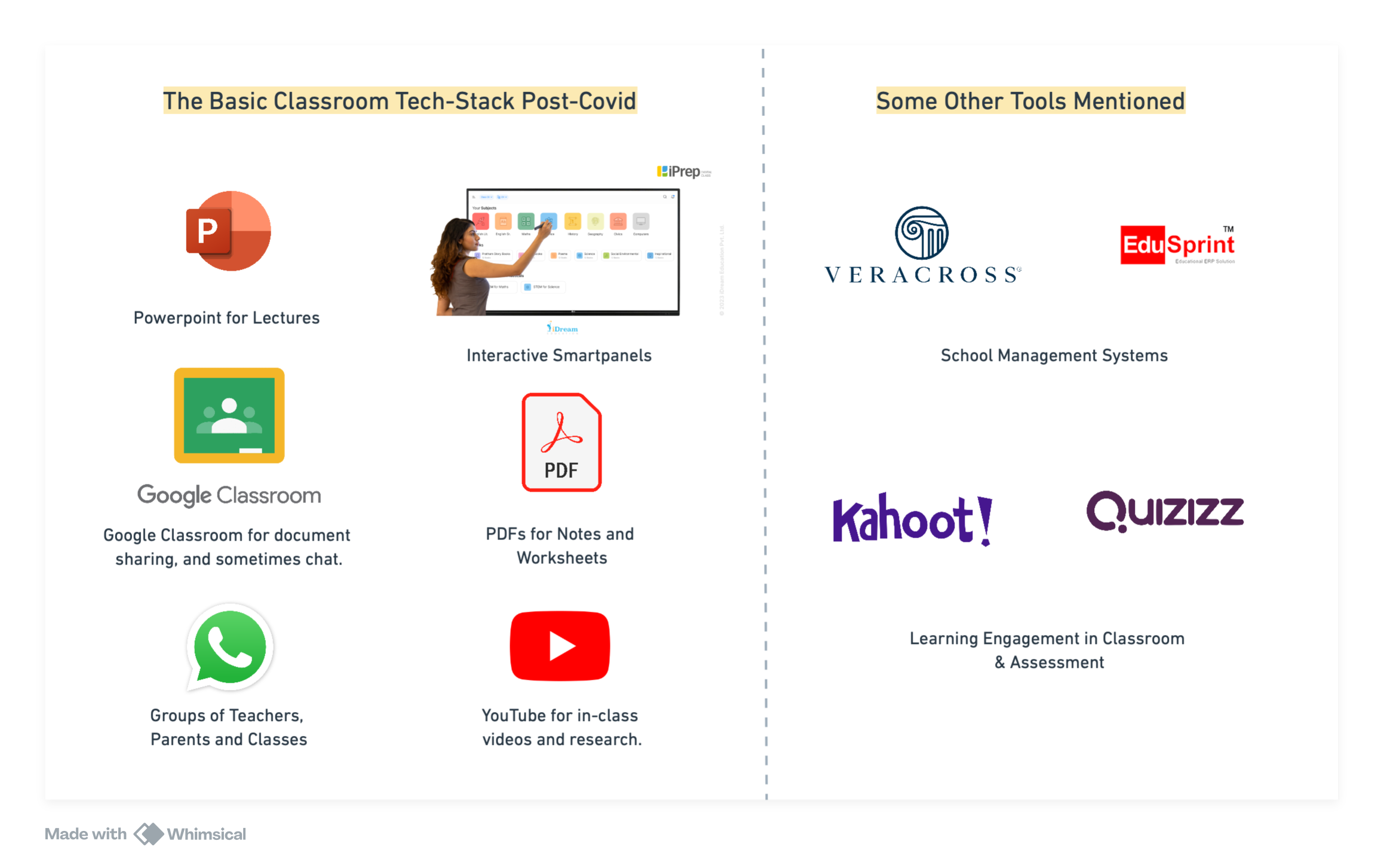
Almost all the teachers I spoke to were doing some level of digital content curation, both to share with students after school and to use in their lectures in the classroom. They noted that ‘watching multiple videos’ to find the most relevant and accurate one was challenging. Especially since students have access to the same internet and come to class having watched these videos. One teacher noted that “students now think they are smarter than us and will watch many videos to one-up us in class without any deep understanding of the concepts.”
Problems with Process
Ensuring three-way communication (parents <> teacher <> student) is a problem for schools and teachers because parents are too busy to pay attention to children’s needs and are not digitally savvy;
Three-way communication is a recognized problem in edtech so much that it was also mentioned in the Blume Edtech Report from 2022 as an emerging core area of focus for companies.
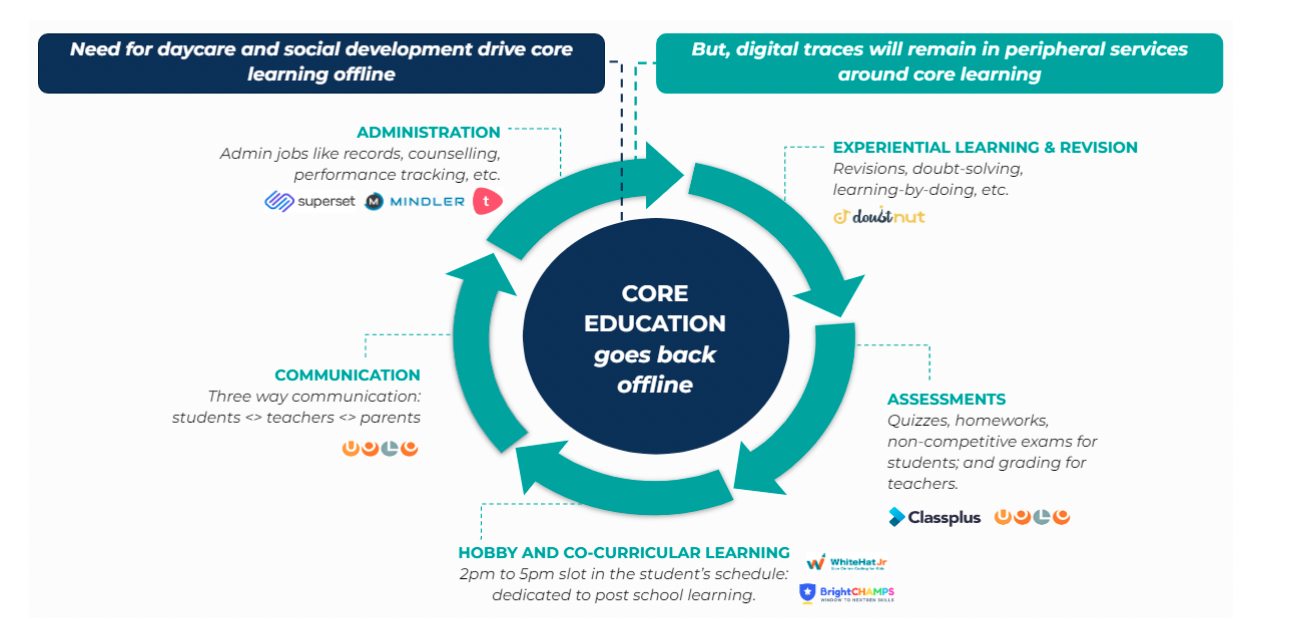
While most teachers I spoke to had solved this one way or another, i.e., using WhatsApp groups or specific software tools – most of them noted that it was a problem to get them engaged, keep them updated about all details of their children’s offline and online presence, and that often parents weren’t even digitally literate enough to understand.
Keeping detailed feedback notes on students is a problem for teachers because of the teacher-student ratio, the attention to detail required for each entry, and the nearly daily frequency;
Similar to the three-way communication problem I noted above, different teachers mentioned different levels of automation in the grading and record-keeping areas of work. To my surprise, nearly half of them said they had used ChatGPT to create assessments like in-class quizzes, take-home worksheets, and exam question papers.
Some Specific Constraints
While speaking with teachers, I also discovered what I had only heard from founders in education before—that building for Schools is a challenging problem.
From what I’ve learned from the calls and my experiences in education, this is because schools are complex institutions with multiple stakeholders and parallel processes and objectives, much like a large business organization.
Keeping this in mind, here are some constraints that became apparent to me:
- Teachers and students are incredibly busy. They have packed schedules. Any solution introduced should simplify their lives and offer clear benefits that justify the time investment. Solutions should fit seamlessly into the existing academic framework and school processes. This is also why promising outcomes is key. Convincing them to spend time on something that doesn’t contribute to their school credits or exam outcomes would be a hard sell.
- Doing anything for the classroom means upskilling teachers and parents. Upskilling teachers and parents is more than just quarterly teacher training sessions. The world is changing too fast for that to work. We must provide teachers with tools to nurture and cultivate their curiosity, just as they do with students. I’m reminded of the OpenAI paper on “Weak to Strong Generalization,” which discusses the challenges of teaching students more intelligent than their teachers (though in a widely different context). As we move forward, this scenario is likely to become more common.
Here’s an AI-generated summary if you made it this far:
- Conducted problem discovery interviews with 10+ teachers from different cities in India to understand their challenges and openness to digital solutions.
- Identified two main categories of problems: classroom problems (requiring pedagogical solutions) and process problems (more suitable for B2B SaaS solutions).
- Classroom problems include ensuring student participation, maintaining engagement, encouraging writing and long-form submissions, and curating trustworthy digital content.
- Process problems include facilitating three-way communication between parents, teachers, and students and keeping detailed student feedback notes.
- Building solutions for schools is challenging due to their complex nature, with multiple stakeholders and parallel processes.
- Constraints to consider when developing solutions:
- Teachers and students have packed schedules, so solutions must simplify their lives and offer clear benefits.
- Solutions should seamlessly integrate with existing academic frameworks and school processes.
- Promising outcomes is crucial, as solutions must contribute to school credits or exam results to justify the time investment.
- Upskilling teachers and parents require more than periodic training sessions due to the rapid pace of technological change.
- Tools should nurture students’ curiosity and empower teachers to navigate the changing technological landscape.

 Dhruv's Website