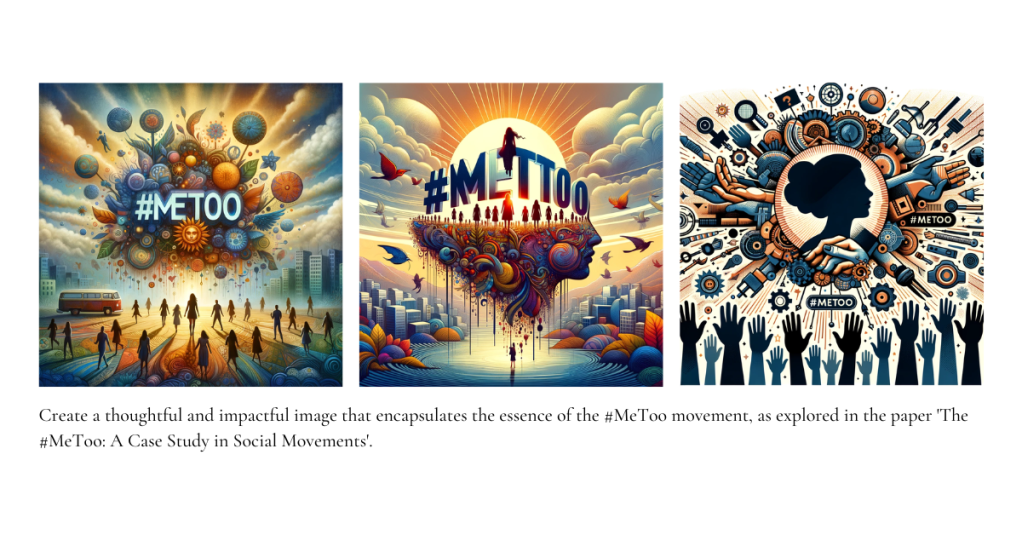
Link to the original – The #MeToo: A Case Study in Social Movements.
On the goals of the paper:
As the title of the paper suggests, the primary objective of this study is to understand the MeToo movement througha approaches of social psychology, with special emphasis on the questions of self-representation of the individual, and construction of a protest model on social media platforms. Considering the bare magnitude and the relative newness of the object of study, it becomes necessary to lay down several secondary and contributive objectives.
The first objective, then, becomes to present a timeline that can aid academic inquiry into the movement through creation of relevant reference points for the organisation of empirical
data toward necessary theoretical analysis.The second objective, of this paper, is to state the existing definitions of social movements and protest and apply them to understanding the nature of the #MeToo movement.
The third objective is to further address the construction of incentives to protest,especially within the paradigm laid down in the second part of the paper, with the purpose of contributing towards a postmodern understanding of democratic participation and collective organisation through protests and social movements.
On the evolution of the #MeToo movement:
The first few tweets took the form of the phrase ‘me too’ being used as declarative statements instead of as a hashtag in the documentary space. Instead of posting personal narratives surrounding individual episodes, the post was used to work as a metaphorical show of hands to emphasise the magnitude of the problem. This mode of protest becomes more relevant
in terms of the first objective of the movement I lay out above, to work towards greater accountability within the existing institutional definitions. It was only once the phrase was made into a hashtag that wording out the individual survivor narratives became relevant, thenceforth
expanding the movement into a discourse of the insidious meanings of concepts such as consent. This allowed the movement to develop from its ‘defensive’ nature into a social movement that can be categorised as ‘offensive and progressive,’ that the movement seeks to change established
social order towards what is considered socially progressive as opposed to a defensive function against proposed changes to the existing order. (Frank and Fuentes, 1987)
On what was unique about the #MeToo as a social movement – it was about the sharing of ‘personal’ trauma.
This offensive nature of the #MeToo movement is peculiar in so far as that it addresses incidents associated with trauma which is increasingly hard to establish in articulation and
expression. Scholars of psychology and psychoanalysis agree that ‘for the survivor of trauma, then, the truth of the event may reside not only in its brutal facts, but also in the way that their occurence defies simple comprehension’ (Caruth 1995: p153). This leads to the conclusion that the representation of trauma, in closed spaces such as that of the Family, the Judiciary, or in the act of testimony, cannot be accessed with complete authority of truth. The complication of representing trauma is further heightened under the cultural implications of Patriarchy which renders the trauma of sexual harassment and abuse as socially taboo, the experience causing ostracisation of women through modes of victim shaming and the interaction of power and gender explained above.In this case, I propose that this presentation of personal traumas as a mode of protest becomes increasingly subversive to the institutions and the ideology of
Patriarchy, in its very essence. It is not that the public representation of trauma hasnt been addressed prior to October 2017, but there is a curious change in the mode of it, which can partially be explained by understanding the construction of identities of the self on the digital medium and the social media mode of communication.

 Dhruv's Website