On genres as a way of talking about “generic categories” and “social categories”:
In his essay, Generic Transformation and Social Change: Rethinking the Rise of the Novel, Michael McKeon introduces a theoretical framework to look at the construction of genres, the problem of signification. He provides a twofold answer by distinguishing between, ‘generic categories’ and ‘questions of truth’ that inquire into them, and, ‘social categories’ and ‘questions of virtue.’ While the former concern “attitudes toward how to tell the truth in narrative,” the latter examine “attitudes toward how the external social order is related to the internal, moral state of its members (McKeon, 1985).”
I propose that in the case of the Internet Meme, the signification doesn’t restrain itself within the neatly-defined boundaries of narratives and literariness, as in the McKeon essay. They present, instead, a form of speech, that combine social and generic categories to be concretely located in the particular space and time of the twenty-first century.
On genres as primary or speech genres and secondary or literary genres:
A genre presents a form of organisation between individual textual elements and creates a proposed epistemology, an intended structure of understanding. It serves two important functions; it establishes the patterns of association between individual textual elements, to extract intelligible meaning; it differentiates these patterns to classify particular forms of meaning. Speech genres, primary genres, are exclusively associated with the first function…
On memes as multimodal, social media texts on the digital medium:
In his book Changing Our Textual Minds Van Der Weel characterises the text, the medium, and, the mode. The text is “a system for the inscription of linguistic utterances” which is brought into being on a medium, in a mode.
Weel defines a medium as “instruments we use in the process of communication.” Print, is an alternative to writing, as is the digital medium, for mediating the language accessible to the reader. Modality is similar “to what in computer terms is called a data type (Weel, 2011, p59).”
The Internet Meme, in popular culture, is most commonly represented by a combination of an image and script. I propose to read the structure of the meme−the language and the image, denoted as a picture−as a redefined text i.e a system for the inscription of linguistic experiences.
The meme is a speech genre, in itself, unique to the digital medium, which is constructed in many modes – it includes the script, the image, the combination of them, and the whole which is made for vitality and shareability on social media.
Introducing the ‘when’ meme:
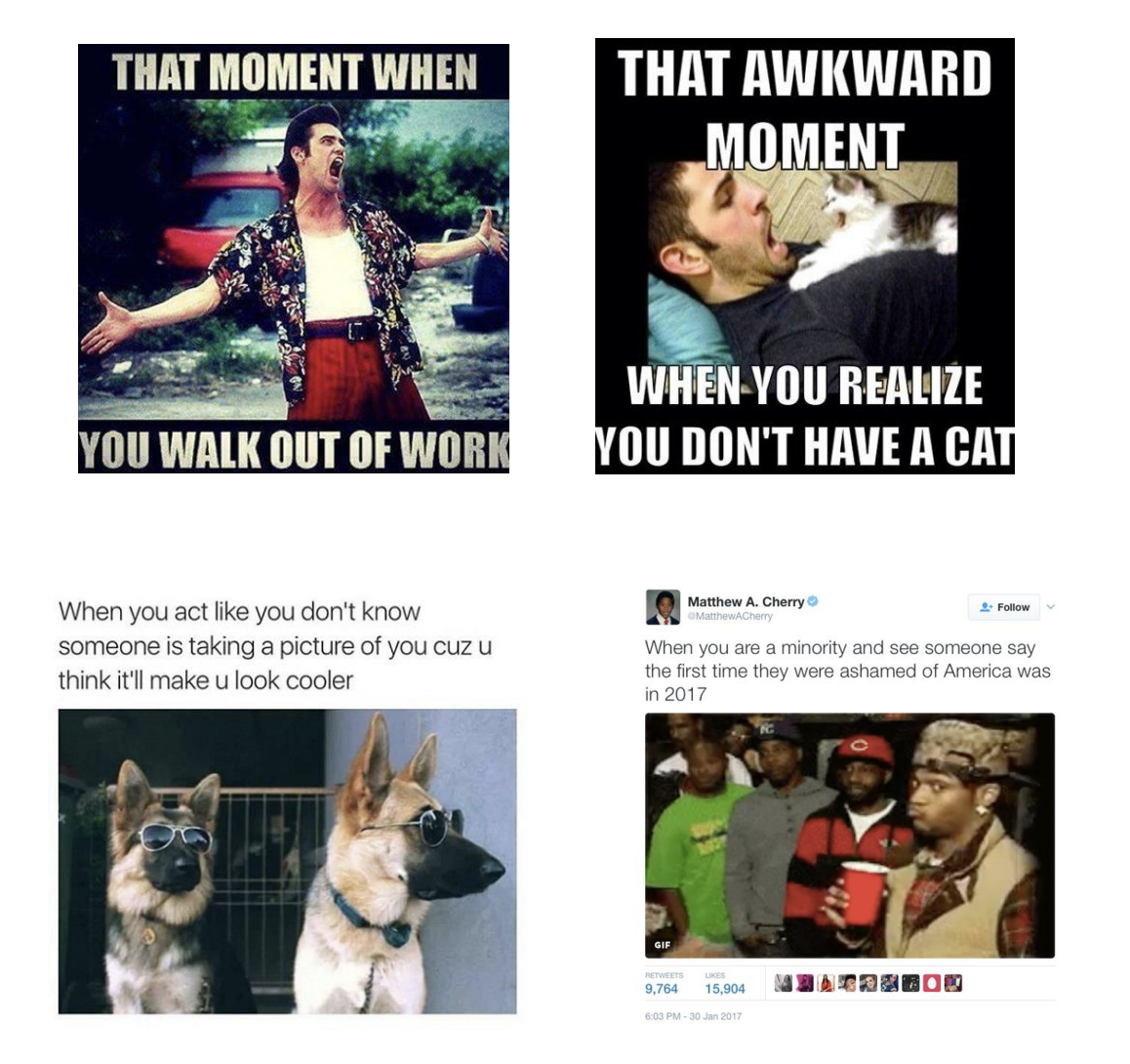
If one views the trajectory of the Internet Meme culture, it becomes possible to discern a trend− the use of statements that begin with ‘when’ placed next to an image that represents an unrelated reality, characterised by exaggerated and detailed emotions.
The images with exaggerated and detailed emotions are mostly sourced from popular culture and the wider social media space.
There is nothing common about the memes beyond the use of the word ‘when’, with variations such as ‘that moment when’ or ‘me when’. Everything that follows the ‘when’ is unstable – both in its ‘content’ and in its ‘existential’ state.
On the problem of creating meme genres without accounting for them as multimodal texts on the digital medium:
Focusing solely on the first meme which features an extravagantly expressive Jim Carrey, the relationship between the image and the script is not established by any reference to their individual meaning. The script in the meme ‘that moment when you walk out of work’ itself does not tell me the true meaning of the meme any more than to say that the meme is about Jim Carrey. It is only when the alphanumeric ‘script’ can be read simultaneously with the ‘image,’ – in multimodality – that the meaning of the meme becomes clearer, which is closer to ‘an extravagant, nearly comical celebration of joy when leaving work.’
Moreover, even though there is very little common between the Jim Carrey meme and the one with the man his cat, it is perceptible that they belong to the same genre of internet memes. This is nothing to do with the script and the image of each meme, or even the meaning of the combined whole. What is common between them is that they both relate to the expression of some exaggerated emotion in a temporal instance connotated by the ‘when.’
Concluding with saying that reading the meme in this way reveals the limits of non-digital modes of communication:
The meaning of the meme is not shaped in the objective form, contextual or structural, but is established from within the use of a complicated linguistic activity which reveal the barrenness of non-digital modes of communication. Research has already established that there are significant ways in which “social media contexts challenge or transform” theories of “interpersonal interactions and communication,” including, the Social Network theory and the Social Contagion theory (McFarland and Polyhart, 2015).”
Reading the meme in ways that relate the alphanumeric text with the visual, toward the creation of an alternate linguistic mode, which allows for contextual displacement and structural reorganisation of each individual element, urges us to ask questions about what is it that is being communicated in these newer models of human society.

 Dhruv's Website