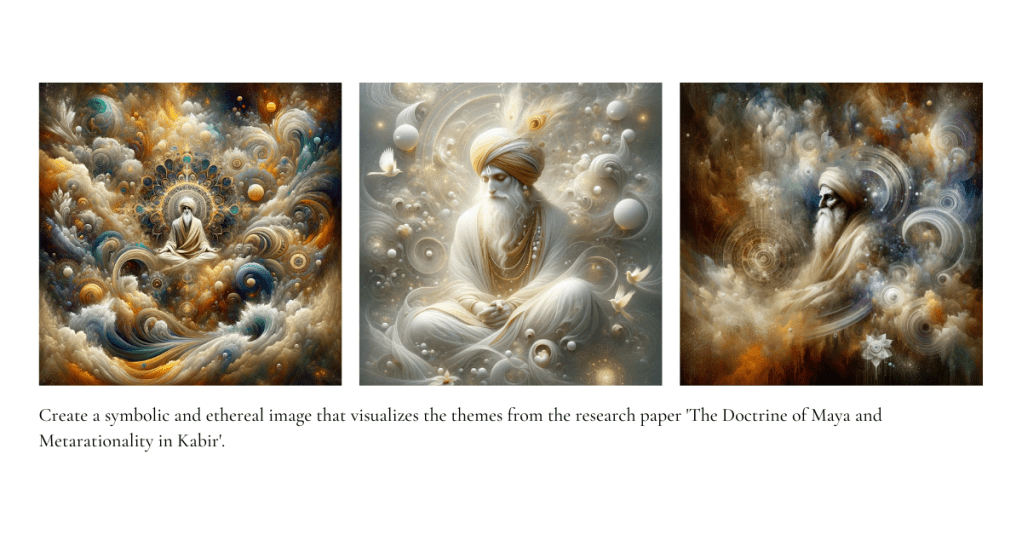
Link to the original: The Doctrine of Maya and Metarationality in Kabir.
To set context:
A fundamental theme of Kabir’s poetry is the oneness of being—a universal oneness which pervades the individual self and the material sphere of human existence—a unity of the atman (the individual self) and the brahman (the absolute metaphysical reality). This theme makes him even more relevant now as India falls into patterns of, what Kalyani Chadha, in a 2018 article titled From Caste to Faith: Contemporary Identity Politics in a Globalized India, refers to as, “faith-based Othering.”
The question of religion, and religious identification, is concerned with the principles of difference and unity, and the way in which they come to interact in a given social system. An important doctrine that lays out a system bringing these two principles into curious contact with each other is the doctrine of Maya…’Appearance’ and ‘illusion’ are adequately
representative of the complete meaning of the word (9). Kabir, like various other Bhakti poets, argued for unity across these religious identities, and the differences, in his literature,
were explained away as illusory and deceptive. This was true across Hindu and Muslim mythologies and scriptures.
On the stories of divine gods fighting divine wars being stories or Maya:
In response to Kabir’s,
“Parshuram never slew any princes,
Maya pulled that trick. (45).”The structure of the poem, in typical Kabir fashion, is relatively simple—he picks up instances of divine action and declares them to be “Maya’s delusion.” Parshuram is not the only one who is pronounced a non-entity. Buddha, Raghunath, Krishna, are all claimed to have performed none of the godly feats which are conventionally attributed to them. Kabir notes that the followers of such human gods, those who “call these the maker,” are “witless,” and “reel[ing] in confusion.” He ends the poem with a concise statement that acknowledges the primacy of a universal creator, over these anthropomorphic characters, saying “only second things bloom and blow (46).”
The two verbs, “bloom” and “blow,” are representative of the processes of creation and destruction. The creator cannot be who creates and destroys because the act of creation and destruction are ‘second’ or themselves ‘created’, since they must come post the moment of creation in the divine sense.
On names of objects as Maya and a barrier to knowing the true nature of things:
Kabir thought that the universal illusion of difference was composed in the same structure as the system of language. This is also relevant to the development of the concept, in the Vedas and the Upanishad. The doctrine of Maya, as developed by Shankara, an eighth-century philosopher and theologian, under the Advaita school of Vedanta philosophy, holds that the multiplicity which is evident in the empirical universe is achieved by the “imposition of name (nama) and form (rupa) (Shastri, 106).”
Kabir also makes use of the concept of nama, so as to suggest that various differences in religious identities are only a result of trying to understand them as objects to be known, and hence, allowing them names to be referred to as. The practice of naming, as long as it exists, renders it impossible to achieve the unity of all experience, the individual self, and, the absolute metaphysical truth, since an object to be known creates the necessity of a knower who is distinct from it. Once a knower is conceptualized, in this manner, with names to represent them and the object to be known, respectively “both sides are lost in schisms (51).”
On the dual nature of Maya or illusions as deceptive and wonderful:
In response to:
“The ten avatars are divine malarkey…
So many ornaments, all one gold,
it has no double nature.
For conversation we make two (Hess and Singh, 51).”Malarkey is defined as ‘meaningless talk; nonsense.’ A careful reader will be immediately struck by the dissonance in the two words, ‘malarkey’ and ‘conversation,’ together, to represent the same idea of an illusory reality. Malarkey is meaningless, but conversations are how we create meaning in the world.
This must not be read as a contradiction, instead, only representative of the two meanings of the word Maya through the centuries. Shastri notes that Sayana, a commentator on Tradition from the Rig Veda, “seems to waver between these two meanings.” Mayabhih, a version of Maya, is explained as “kaptavisesaih (lit. “by special stratagems, artifices”)… it may also mean “prajnabhih” (“by wondrous powers,” Griffith) (9).”
Maya, hence, from the vantage point of a creator is representative of their power to create, but when subject to this creation, it becomes illusory or delusional.
On Kabir’s experiments with the form of his poems:
These texts denounce the principle of difference, in form and in content, and through metarational experiments with the very medium of communication. Kabir’s use of the ulatbamsi, what Hess says is an “”upside-down language” of paradoxes and enigmas,” can also be viewed as the outcome of metarational thinking, as the creation of such a
nonsensical order represents an awareness of the innately deceptive nature of stable names and categories, as they exist in language and cognition, and the want to play with them. The capacity to make use of the ulatbamsi to critique social ills, toward creation of a progressive future, may then be likened to the power of illusion, of Maya.

 Dhruv's Website