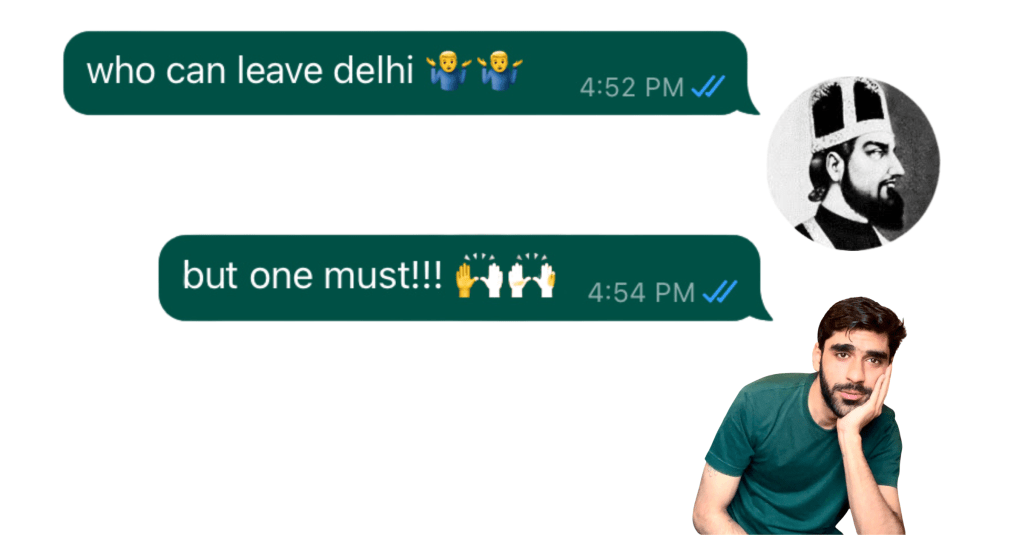
Some Wikipedia notes on Zauq – Sheikh Muhammad Ibrahim Zauq (1790–1854) was an Urdu poet and scholar of literature, poetry and religion. He wrote poetry under the pen name “Zauq”, and was appointed poet laureate of the Mughal Court in Delhi just at the age of 19. Zauq was born at Delhi in 1790. His natural bent of mind towards poetry coupled with his singular obsession to excel in the pursuit brought him fame and fortune. Zauq died in 1854, and today his grave lies in a bylanes of Paharganj, Delhi. Major portion of Zauq’s poetical output got lost because of mutiny of 1857.
Some notes on when I wrote this: I wrote these originally in end of March, 2022, nearly 15 months from when I am writing this post. I was in the middle of moving from Delhi to Bangalore then, and a lot of that experience for me was just as much about “leaving Delhi” as “moving to Bangalore.” These poems mostly concern me coming to terms with leaving Delhi. What better way to come to terms with that than by talking to the most vehement opposer of leaving Delhi – Zauq. Maybe just maybe, if I could justify leaving Delhi in response to Zauq, I could also, justify it to myself – and reasonably.

Zauq’s Original Poem and Translation –
I first discovered his poem on the streets of Delhi in the film Delhi 6 – Rishi Kapoor reads out the second half of it in a beautiful scene – watch it in the first minute here. Can’t find too many details about when it was first published, but rest assured it was published in Delhi.
in dino garche dakan mein hai
badi qadr-e-sukhan
kaun jaye ‘zauq’ par
dilli ki galliyan chhod kar
These days, although, in the South
There is much reverence for poets
Who will go, Zauq, but
Leaving behind the streets of Delhi
A Response –
“Zauq, dear, one must,
leave behind
the streets of Delhi,
How else will the heart ever
build its own
Dilli.”
Another Response –
“The streets of Delhi, Zauq,
are now no more,
than a parking lot
for forts and citadels
one must leave them
for a piece of land
to build a home on.”
 Dhruv's Website