As posted on LinkedIn here, on May 1, 2021.
I completed 6 months at Genpact last month, on the 5th of April. In this time, I have had the opportunity to learn more about the world and myself. With a continuous interest in the nature of experience, I noted down a few realisations. To keep myself honest, I decided to put them on the internet. These are general statements about Scale, Change, Teams and Learning.
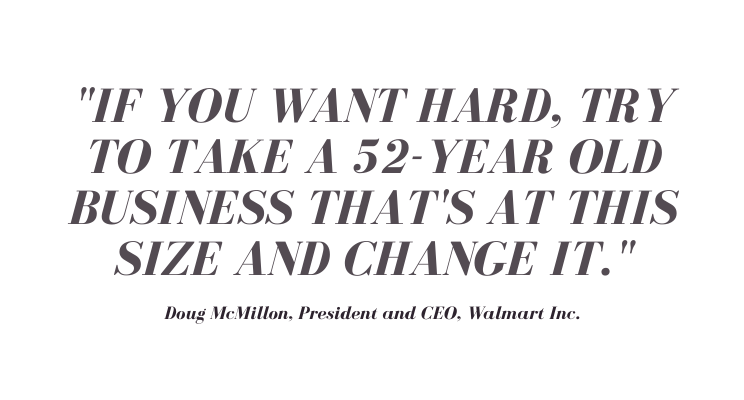
- Culture is very important, especially at scale: In a 2015 interview at the Stanford Graduate School of Business, Doug McMillon, President and CEO of Walmart, says “If you want hard, try to take a 52-year old business that’s at this size [referring to Walmart] and change it.” At Genpact, I have come to truly appreciate the problem of scale that Doug mentions. There’s a necessary operational part to it – a problem of distributing resources. That, I am convinced, has been solved much with advancement in information technology and globalisation. The challenge now is primarily cultural,of regulation not distribution – ensuring that 100, 000 people follow the same decision-making framework, deliberate processes, and organisational priorities.
- Agility is a deliberate method of dealing with emergence: Along with scale, the other element which Doug points to, is change. Historically specific or not, it is true that every sphere of our world is currently changing. My limited conception of industrial change as Christensen’s disruption was significantly expanded as I joined Genpact during the COVID19 pandemic. In this context, agility emerged as a recurring theme in my early conversations at the firm. I have much to learn about being and working with agility, but its been liberating to be introduced to thinking of positioning against various possibilities instead of predicting perfectly determined future-states.
- Execution is the best way to learn and grow: I work on a fixed-duration internal integration program and we run multiple versions of it every year. This makes it a brilliant canvas for learning through deliberate practice because I get to do it repetitively and with real-time feedback on my performance. There also appears to be a seemingly eternal injunction to execute in a rapidly changing large-scale organisation. These things together have helped me realise that rapid execution helps escape analysis paralysis and enables accelerated learning. Additionally, this process has to be uncomfortable in the short term, because it is challenging to execute rapidly (with limited information). Hence, one must learn to tolerate failure.
- You’re only as strong as your team is: There have been many seemingly innocuous times in the last six months when doing something myself has seemed the quicker/easier choice, but in the aggregate these have mostly led to negative outcomes such as running out of time, shoddier quality than usual etc. I now realise that there is immense value in working for, not only the transformation of your customers, but also the transformation of your teammates. The math is the same as that of investing time in your own transformation – it has exponential returns in the long-run, which are collectively beneficial.
In conclusion, I would like to add that I do not claim any of these to be universal or authoritative. Instead, this is a very intentional attempt to encode my experiences in a language fairly foreign to me. I would like to carry these realisations to my future and return to them for reflection and updates, with the hope that I will learn to be more articulate in this language through the process.

 Dhruv's Website