In my last post about reflections upon the self, I registered a suspension of reality, that life in a global pandemic feels surreal (here’s a WIRED article about it). Picking up from there, as I hang somewhere over nowhere – suspended – I am, these days, considering everything in great detail. I am reflecting upon all phenomena and my experience of them and only because a virus, 120 nanometer wide, managed to enter our collective body, our system. The center did not hold, as it had not for Yeats in 1920, and all our progress broke away in more parts than most experts could expect in their deliriums of predictive exactitude.
Margaret Atwood, in a recent article for the Time magazine, likens our present condition to that of a knight who “gallops toward a castle just as its drawbridge is going up,” or of “cars sailing over rivers via lift bridges.” She notes that “we’re in midair, hoping we make it to the other side, where life would have returned to what we think of as normal,” and this must be as true as allegories can be, for even as the COVID19 pandemic has shaken the economy, the international order, politics, and, technology, I see us waiting for the return of a normal – a state of normalcy. I see it in text messages that create and recreate memories, of the time we could go outside, of the time we could drink and be merry– ad infinitum, ad nauseam.
The question Atwood asks and answers is “what should we do while we’re up there, between now and then?” She suggests that we “[t]hink of all the things [we] hope will still be there in that castle of the future when we get across.” I have a different suggestion to make today. We must carefully examine the “castle of the future,” and not just what should be in it. We must build and rebuild the castle as many times as we can, while we’re still up here. As things fall apart all around us, I propose that we should raise as many important questions as we can, play with as many frames as we can. As generic as this sounds, there is a need for this to be stated, and stated with deep intention. One such question is of the moral implications of the pandemic.
Time in my residence hall, at university
is currently paused. It is running out
in a narrow tributary, of a river that is
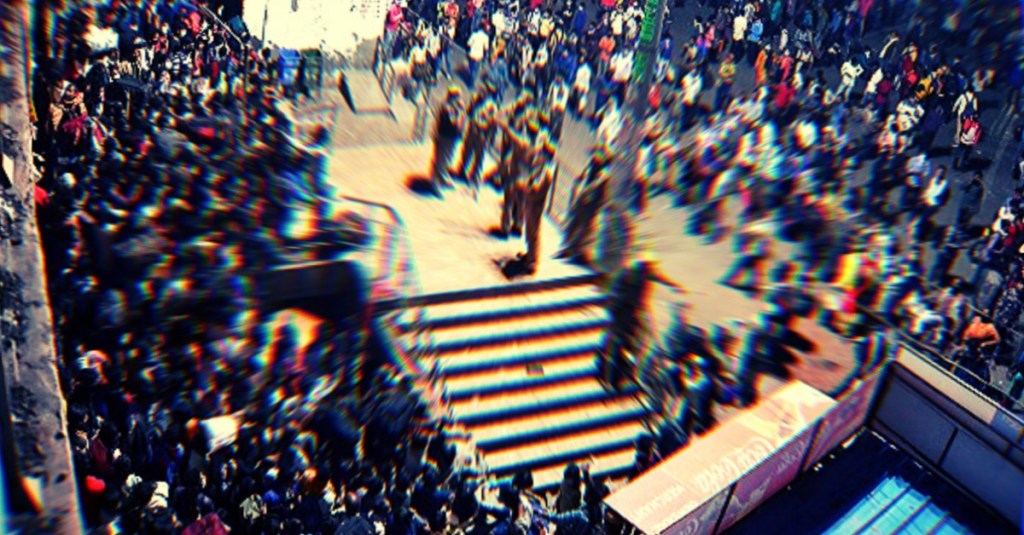
flooding elsewhere. I am taken to Anand Vihar,
a bus stand upon the border of Delhi and Uttar Pradesh.
This is as it is, for me.
This pandemic must not be thought of, remembered, as a break from the regular processes of being. Instead, it should enter the pages of our history books as an incredibly powerful experience that has and will redefine everything we’ve known of the world. It must be mapped as a shock to our material establishments, and a shock to our current narratives, models, of the self – a crisis of material, a crisis of self – a moral upheaval in modern history.
Normal will never return, neither in the world, nor within. If there must be such a divide to begin with. I think this is what Atwood means when she says that “[i]t’s the best of times, it’s the worst of times,” and “[h]ow you experience this time will be, in part, up to you.” She says ‘in part,’ because the truthfulness of this reality is not contingent upon belief, it is true whether or not we believe it to be. Research has established the relationship between society and the self. The WIRED article above cites some of these studies. The world is changing, we are changing, and we have the choice between ‘realising that change’ or ‘letting it happen’ to us.
Rabindranath Tagore would not agree. He would note that I draw a distinction between ‘realising’ the change and the change ‘happening’ to us, and would “be compelled to utter a truism,” as he does, in a response to Gandhi’s characterisation of the 1934 Bihar Earthquake. Tagore wrote that “physical catastrophes have their inevitable and exclusive origin in certain combinations of physical facts.” In this Logic, natural disasters such as the viral pandemic, in their very nature, happen to us. There is truth in this, and I would not say that the pandemic is divine condemnation for the excesses of global capitalism, as Gandhi had done with the Bihar earthquake and untouchability.
We must, although, realise that our actions, once performed, become physical facts of their own order. The drives that motivate these actions are just as much ‘moral’ and ‘spiritual’ forces as primordial reflexes. Even if “our own sins and errors,” as individuals, do not have the “force to drag down the structure of creation to ruins (Tagore, 1934)” we do have the capacity to perceive those that do, such as the abrupt and arbitrary declaration of a national shutdown. We have the capacity to see the impact of this natural event on our lives and map it to causes both natural and manmade.
Government and private bodies around the world have issued guidelines to deal with the stress and anxiety yielding from the pandemic. The catastrophic effects of it are not limited to the inside lives of those who are staying at home, watching the world economy crash. It is, in fact, being experienced in greater truth by individuals who are made collectively obscure under categories such as ‘migrant labour.’ The lies that underlie narratives of urbanisation as a means to better standards of living are now made white in the pictures from across the country. An article in Science magazine, titled, The moment to see the poor, after a statement from Pope Francis, notes that the “pandemic has illuminated inequities that have put poor people–in both low-income nations and in rich countries–at the greatest risk of suffering.”
I do not know what is normal
in a life constantly suspended
in a constant state of uncertainty
over security, upon the daily wage,
but whatever must be it, is disrupted.
Moreover as Gandhi notes in his response to Tagore, “physical phenomena produce results both physical and spiritual.” We can become better people by experiencing the pandemic in its completeness, recognising that we’re, first and foremost, natural and moral subjects who are changing with and as the physical world. Only after that are we our stable selves, Netflix and Chill-ing, waiting for a normal that’ll never come. It would be the waste of an opportunity for immense growth if we never interrogate the former change to the fullest extent.
Arundhati Roy makes a similar point in her Financial Times article on April 3rd. She says that the current pandemic, like its historical predecessors, “is a portal, a gateway between one world and the next,” and that all of us can “choose to walk through it, dragging the carcasses of our prejudice and hatred,” or be “ready to imagine another world.” To imagine another world is not an easy task, especially as history weighs our imagination down with images of castles and roads. “A thorough review of worldviews, lifestyles, and the problems of short-term economic valuation must be carried out (Science, 2020).” I am hopeful, though, because the protests in response to the passing of the terrible Citizenship Amendment Bill were clear presentations of the moral fervour that characterises our society.
In Anand Vihar, time exists, perhaps even more powerfully than it did before the pandemic. It is because of the pandemic that I can now perceive these varied temporalities and the experiences that they cause and support, and much like Gandhi, I speak “with the greatest deliberation and out of the fullness of my heart.” I can choose to believe this to be true, by this I mean “the connection between cosmic phenomena and human behaviour,” or forget it and immerse myself in the flow of that narrow tributary and call it the Ganges.
 Dhruv's Website