The modern day has really complicated the process with which the poet and the reader can interact with poetry. Just as evident in the evolution of music, so in poetry, the emphasis has moved from romantic imagery that can construct complete experiences, into experiences that are unified into instances of emotion or feeling. What do I mean? Well, considering this isn’t a post on the evolution of music or poetry, I will save much documentary space by presenting a rather rudimentary analysis for the same. When I say rudimentary, I really just mean two lines of it, at maximum.
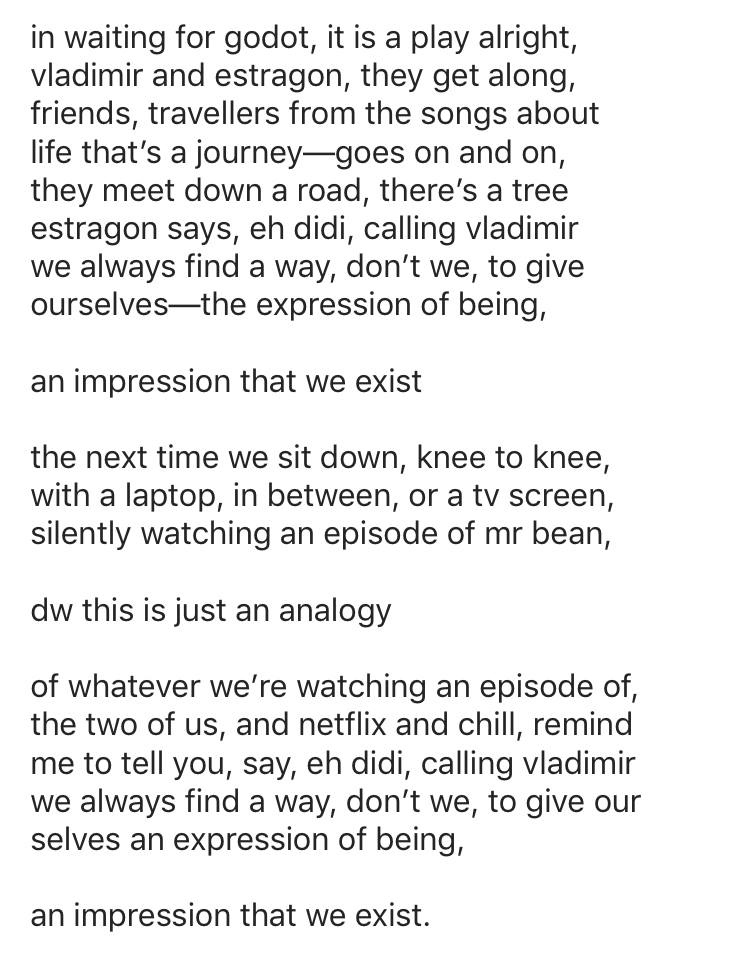
read #waitingforgodot for a #drama class. #netflixandchill. I wish i could put things better. Is all #poetry on #socialmedia dramatic monologues? @NetflixIndia pic.twitter.com/bRaqnAp1D7
— Dhruv Trehan (@dhruvtrehan9) March 24, 2019
What prompts critics to say that Rupi Kaur isn’t a poet–because what she recreates in her poem, isn’t a narrative or a representation heightened from its reality into a romantic grandeur, leading up to a final moralist consequence or conclusion. She, instead, recreates, instants of emotion that aren’t leading up to anywhere but combust in their own experientiality. How do I share poetry, in the modern day? Do I make it into an image because people find it easier to read the text in an image than text in a document, should I caption it with hashtags to ensure greater engagement, do I title it and leave the title there, or do I explain the authorial intent — what does social media want from poetry?
so now everyone knows I read waiting for Godot for the modern European drama paper. also is this a dramatic monologue, what is going on? I have edited this caption, is it a status, three times now. isn’t everything on social media a dramatic monologue?
Netflix and Chill, While Waiting for Godot.
in waiting for godot, it is a play alright,
vladimir and estragon, they get along,
friends, travellers, from the songs,
about life that's a journey—goes on and on,
they meet down a road, there's a tree,
estragon says, eh didi, calling vladimir,
we always find a way, don't we, to give
ourselves—the expression of being,

an impression that we exist

the next time we sit down, knee to knee,
with a laptop, in between, or a tv screen,
silently watching an episode of mr bean,

dw this is just an analogy

of whatever we're watching an episode of,
the two of us, and netflix and chill,
remind me to tell you, say, eh didi,
calling vladimir, we always find a way,
don't we, to give our selves an expression
of being,

an impression that we exist.
 Dhruv's Website