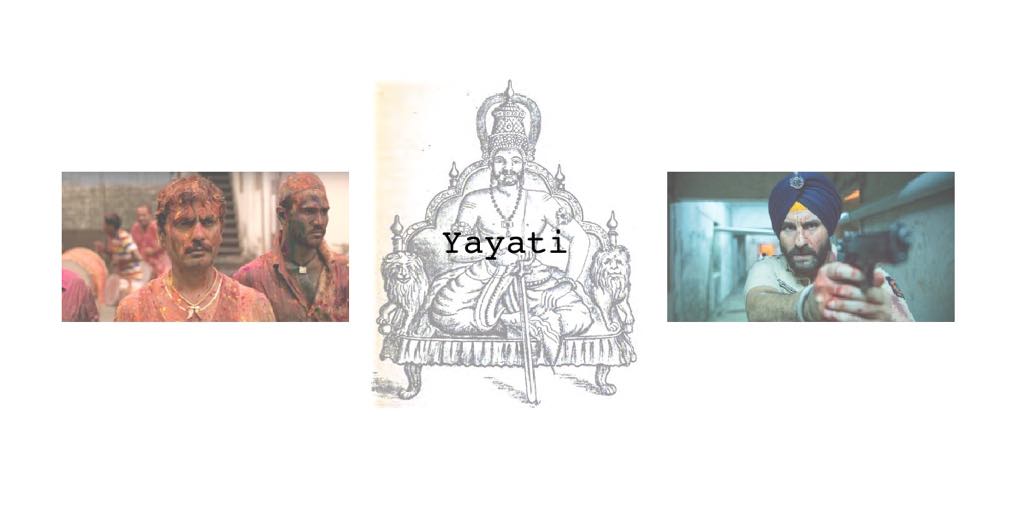
In Episode 8, of the First season of the Netflix special, Sacred Games, the show introduces the viewers to the concept of Yayati―a strain of thought that runs deep into the tangled tales of the gang-leader, Ganesh Gaitonde, and the mediocre cop, Sartaj Singh. A character, played by Pankaj Tripathi, positions the Yayati complex as the Eastern complement of the Oedipus complex―first studied by the Austrian psychoanalyst, Sigmund Freud. Entirely opposite to the story of Oedipus Rex, which creates a universal standard of the Son and the Father competing for the love of the mother, the story of Yayati supposes an eternal burden, in the name of the Father, that the Son is destined to carry. The story goes that in the prime of his youth, King Yayati happens to bear children with his mistress, Sharmishtha, and in doing so, breaks a vow made to his Father-in-law Shukracharya. In punishment, Shukracharya curses Yayati with old-age, a predilection that Yayati would have felt rather too keenly, considering his sexual and political exuberance in the glory of youth and its promises of eternity. Yet, Shukracharya allows Yayati a very clever exit; he could, if possible, exchange his old age with the youth of one of his children, and escape these complications. King Puru, the youngest Son of the King of Kings, agrees to the transaction for the love and respect that he holds for his Father. Soon, the old man turns into a younger version of himself, and the Son bears all the afflictions that the passing of time brings with itself. The King, then, as the literature would tell you, pursues all the pleasures of the senses and realises the pointlessness of age, and the human consciousness, since nothing leaves him satiated, and he declares Puru as his rightful heir, and exchanges the youth and the old age again, paving the way for the line of Kurus, the Pandavas and the Kauravas, and the tapestry upon which the Indian existence is charted out, the Mahabharata. What are the implications of this particular myth? Devdutt Pattanaik, in a blog post on his website, says, “In Hindu narratives the hero is one who submits to the will of the Father, society, and tradition. Obedience is the highest virtue. He is the good Son. He who obeys. Surrenders. Submits. Because the Father knows best. Father must win in the Indian tradition. Father is tradition. Father is the great keeper of cultural values. His indiscretions must be forgiven.”
This particular way of being, in the opinion of this reviewer, leads to a constant pressure on the shoulders of the Son by making him aware of the realities of old age, sooner than he has had the chance to enjoy the vivacity of the human youth. That is to say, because of being made aware of the final fate of the breathing exercise, sooner that one should be, most men in the Hindu consciousness never get to realise their youthful selves. Remember, old age and the circle of ‘death and life’ are some of the most potent symbols of existentialist despair, all across continents, and, cultures, and, mythologies. Buddha renounces everything upon being pushed to the edge by the sight of a bereaved old man and, it is, indeed, another old man who shows the way and the purposelessness of all pursuit to our dear-old Doctor Faustus.
Having said this, I propose to read Sacred Games as another narrative that pushes ahead the Yayati myth, or what I call, the King Puru complex―a Father who gets to leave behind his youth for the pleasure of his Father, and a Son who carries the weight and complications of the Father’s choices on his back―as the rightful way of living, theory that lines with the creation of a hyper-patriarchal and filial society. I intend to do this by analysing the Fathers and Sons of the shows, particularly the two parallel tales of Fatherhood; the relationship of Ganesh and his mendicant Father, and the simultaneous vacuum of suffering and responsibility that leads to the idea of the first Father, the second Father, and the third Father, and, that of Sartaj and his Father, a relationship morphed into a weird neurosis by the two oppositional identity-forces of his Father as a Father and his Father as a police officer.

It is interesting to see, that the gangster, Ganesh, does not, in any manner, fit the bill to be the King Puru of Yayati’s myth. Instead, it is fair to say, he’s a terrible Son, and as opposed to the Son giving up everything for the sake of his Father line of thought, it is, instead, his mendicant Father who literally gives up everything he has, most importantly, his liberty, to save his Son from going to jail for murdering his own mother, and her lover. Fair to say, that to establish Ganesh as the reversal of the Father myth isn’t a very far-fetched idea, and the traces of a conscious distortion, of the same kind, are evident to anyone who cares to look into the little details.
But what really is the emotional relationship that the two, Ganesh and his Father, share with each other? We know that Ganesh comes to detest his Father because of his state of poverty, and mendicancy. He hates the fact that he has to stay alive on the little his Father can manage to beg for. This particular episode in the life of the gangster really becomes a defining attribute for his behaviour towards the people in his life, it is, indeed, the lack of a Father figure that urges him to create these smaller and smaller compartments in his story, identified by who became his Father when, whether it be the Hindu Hotel man who teaches the man about the perils and advantages of religion, or the third Father, who lowkey gets him involved in a plot that seemingly involves some biological warfare and a potential genocide. Hence, Ganesh Gaitonde is the worst Son of all times, he is literally okay with sending his Father to jail, and somehow, even though the same behaviour remains subliminally important to the actions of his perSon, he doesn’t seem to realise the weight he carries with himself because of this particular situation. Think about how in the phone conversation between him and his third Father, he never really ends up asking for an apology for the way his being had impacted his biological Father—killing the mother comes back to him, but having his Father rot in jail? Nope, nada, absolutely nothing.
On the other hand, it is safe to say, that Sartaj and his Father, share, at least on the surface, a completely different relationship. Sartaj adores his Father, or would have himself and everybody around him believe so. From the very beginning of his story, in the way he deals with the fake encounter and the dishonest of his senior, he suffers a doubt in the pursuit of his self-interest. Interestingly, even though, the things he has to do to want the best for himself can be seen as conventionally immoral, the doubt he suffers is not aligned with considerations of this morality. It is against the whetstone of the values his Father had invested in the conceptualization of the job of a police officer that he sharpens his resolve to not testify, even as he eventually does. He, Sartaj, suffers a moral and an emotional crisis, where he isn’t able to reconcile the path he wants to pursue, and the path his Father has laid across for him. Sartaj, in his act of giving a false testimony, turns into another Ganesh, causing a failure of the Yayati organisation, but maintains a veneer of the filial devotion. He never shares the information with his mother, and even when he’s recalling the incident to his friend and comrade, the sub-inspector Katekar, he doesn’t really articulate his despair out loud but retells the tale of the time they planned a vacation to Amritsar, and couldn’t go because of his Father’s commitment to his job.
I propose to read this memory as a repressed memory stemming from daddy issues that haven’t been addressed because of the aforementioned mythology. To be entirely honest, Sartaj’s Father is a policeman before he is a Father, that is to say, even when he’s remembered in the memory of his Son, or the people he has interacted with, it is always as a police man, and the virtue he represented in that position, never as a great Father. He was a terrible dad, if anything. Cancelling a family vacation at the very last-minute because he was needed at his job, even though other people could have taken care of it, sounds like an incident that must have scarred the child rather strongly. The Young Sartaj must have been hurt, and extremely sad, as most kids usually are, when their Fathers have to rush away to their responsibilities, paying them no attention and concern.
Allow me to draw a logical leap here. Sartaj is a pretty terrible policeman, if you think about it. He gets involved in the Ganesh case, but he isn’t really assigned the case as much as ‘he gets involved because his Father had taken a random erratic decision of supporting and being nice to a terrible criminal, once upon a time, and now he’s stuck with the problematic residue of the same bad decisions.’ As a matter of fact, if anything, we know that Sartaj has been doing terribly as a cop, because he hasn’t caught anyone except for a small time pickpocket, and cannot stand up to his superiors even at the principle level, and clearly fucks up the escape plan that Radhika Apte so brilliantly comes up with, in pursuit of some fancy-ass self-righteous virtue. He doesn’t realise the boundaries of the perSonal and the professional, making things extremely hard for his friend and comrade, and doesn’t even bother to try to save him first in the incidence of his throat being slit. Instead, he runs after a stupid criminal, and revives his memory of the false execution, bowing down to the animatistic passions of anger and relief by killing him, instead of trying to be the same ‘greater man’ he fancies himself to be before. He bows down to a psycho-orgasmic neurosis, instead of taking his friend to the hospital. LOL.
He also just weirdly goes to all these creepy places alone, and ends up hurting himself, whining, after, like a fucking baby. He shouldn’t have been a cop, he sucks at it, and its purely the dramatic necessity that keeps his story progressing, otherwise, if it was to be left entirely to his actions, not for the involvement of the people around him, he would have died in the warehouse, after losing his stupid thumb. So, if he’s a bad cop, why does he choose to become one, if we were to ask that question? Well maybe, because, he has this intense pressure of following the golden path of virtue that his Father has paved out ahead of him. Maybe, because, it is only in the khaki uniform that he comes close to being able to conceive of his Father as a real perSon, and hence, hold him in his memory. Any mention of his Father as a perSon only comes in passing, and is very effectively sidetracked by the reluctance of his mother to talk about it. For example, the two times we see Sartaj bringing up his Father, and, Ganesh, and, their perSonal relationship, his mother storms off in disappointment and that conversation is given up for another scene involving his emotional and professional inability lol. So, we have Ganesh, who represents the opposite of the behaviour prescribed by the Yayati way of being, and Sartaj, someone who’s repetitively repressing his own self to pursue the same path of existence.
Sartaj’s Father is presented as the Father the Son should give up everything for, the virtuous old Dashrath, even though both of them are just jerks who subject their Sons to a lifetime of struggle simply because they had been subjected to their own lots when they had been young men. On the other hand, Ganesh’s Father, in all ways and manners, is someone who can be classified as a rebel against the patriarchal-capitalist organisation of the Bombay of his time. As is evident in the young Ganesh’s angst, the disappointment with his Father stems from the Father’s inability to provide for his material needs. In the era of pursuing middle-class, lower-class, employment, choosing to stick with religion, even as it means not being able to fulfill the responsibilities of a patriarch, has to be read as a rebellious choice. The nothingness of asceticism has to be contrasted with the imposed multiplicity of a developing urban-consumerist ethos. In rebelling against the structure he has been a part of, he paves the way for a void in place of the claustrophobic filial responsibility in the character of Ganesh, which Ganesh, then, seeks to negate by excesses of crime, and lust, and money, and what not. The burden of religion still carries on, but instead of forcing in the quiet acceptance that stems from the Hindu consciousness, Ganesh rebels against it, and becomes a criminal, abdicating the conventional moral standards for his own. In many ways, it is indeed Ganesh which is the fully formed individual, free, and liberated, and not the police officer, who happens to be trapped in an isolation cell of his own making.
Having noted all of this, what really is the point? Well, I am really just tired of shows that tell us the same tale of a troubled hero, becoming the morally celebrated, purely by a circumstance of chance. Of course, you cannot deny that there is some reserve and rectitude in Sartaj that has to be celebrated, but aren’t all tales always about the resilience of those who are forced into situations of the world, the external? We need to be able to tell stories that identify the causes of those external situations, and move away from artificially constructed, and, very often, self-inflicted suffering. It is not normal for a man who seems barely qualified, qualitatively, to be a police officer to become one, purely because his Father was one and it is his ‘burden’ to live through the high standards of the same. Sartaj is a person on his own. It is okay for him to question his Father, and it isn’t fair for his mother to be angry or shrug at those questions. It is wrong, on the part of Sartaj’s Father, to cancel the Amritsar trip. We need more men who are able to understand the source of their troubles and not simply force a romantic causation of them upon their relationship with the woman in their lives, as Sartaj is repetitively seen doing. Even though his mom would have all of us believe that it is the absence of his wife that is causing him all this emotional despair, the real source of all his problems is really the absent Father, and, the superimposed Policeman, and, this weird as fuck criminal story that the same absent and superimposed spirit has put him in the middle of. Anyone would know, that it is not someone like Sartaj who should be handling something of the scale of the criminal plot at the center of the story.
As far as Ganesh is concerned, it amazes me that the show barely paid any attention to the relationship he shared with his Father. There is no space allowed for that personality to develop, and to the viewer, the simple act of proclaiming everyone as his Father becomes another identity quirk of a cool criminal. Even though the show, like most Anurag Kashyap productions, puts the criminal mind and way of being into an alternate perspective, and makes it super cool to look at, and allow his petty-bourgeois audience the displacement that their routinely structured days evade from them, is the show really retelling the story? Doesn’t the show repetitively make Sartaj the hero, the protagonist, even though Ganesh is definitely a more interesting individual? And while we’re able to think of Sartaj’s actions in respect to his past, somehow, it is only at the time of salvation and death that Ganesh looks back upon his. I am sure that is not how someone who’s killed his mother, and sentenced his Father to a life of jail would live, to unremember. The Fathers and Sons of the show are fucked up, and even as, in mentioning Yayati, it really goes ahead and allows television a grander application and understanding, does it really take the myth with a pinch of salt, and question it? Or purely parade its nakedness around? Obviously the show’s not under any obligation to do any of these things, but I really wish it had, because it definitely shows so much more promise than other shows around. Even though Ganesh would have us believe, that ‘it was at the time of each of their births that the destinies of the two male-leads had been written into each other,’ it was, actually, only Sartaj’s father who wrote the intersection, in his own self; no gods, just men and their mistakes.

 Dhruv's Website