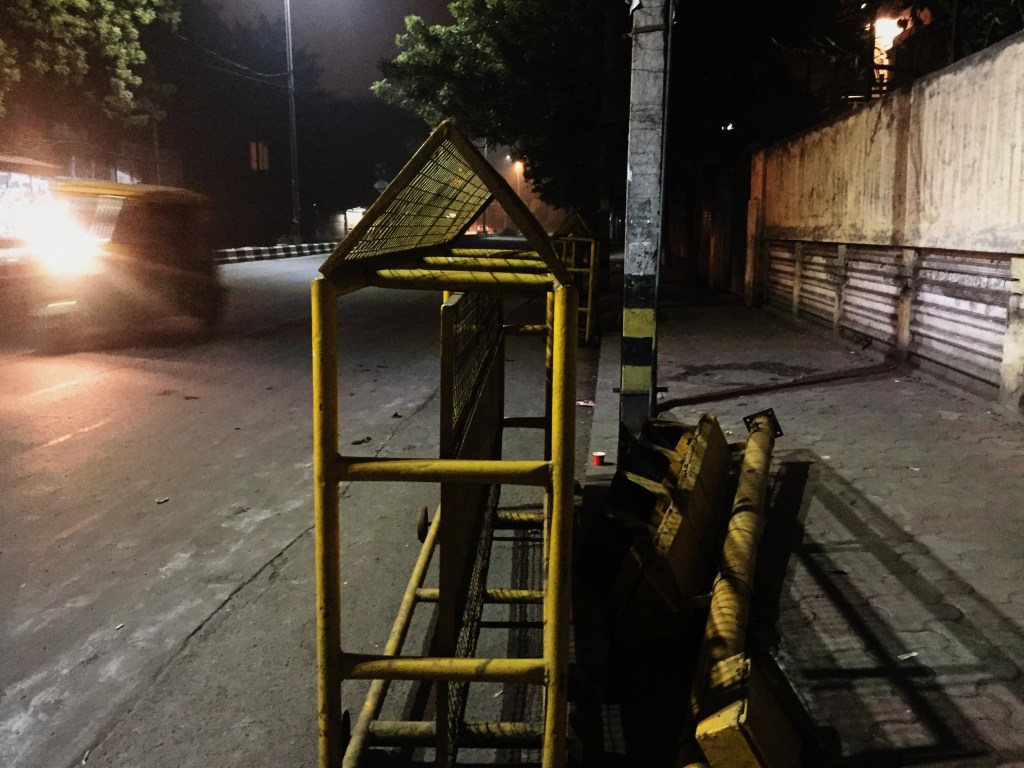
I remember KJ mentioning a motion, once, something about ‘jumping a traffic light.’ Being the forever-unreal, I, of course, misheard it, on purpose, accidentally, and understood it to be, instead, about ‘regretting’ the yellow pillars of imposed order and stability. I couldn’t be bothered to frame arguments in favour of, and against, traffic lights, for fucks sake, but I did manage to ruminate upon the symbology the material objects come to embody, carry, inside those hollow metal tubes, within the larger ideological and surface structures of the modern world.
The traffic light is so ubiquitous that we often come to forget that it is the largest instrument of practising state coercion and compulsion. While the coercion leads to an outcome largely desirable and positive, that remains, in itself, irrelevant to my proposition. Proposition is an unlikely word to choose, for it remains absolutely true. Remember how Weber remarked that the State maintains an overall legitimate monopoly on violence. It has the right to exercise that violence towards actors it deems as problematic to its own design. A design based on, in liberal and democratic thought, the benefit of the society, and the citizenry as whole. In this case, the state is curbing our right to not stop at that point on that road.
We had all the natural right to do it, as human beings, to move around in the World, so craft fully unfolded for us, upon time and space, “And God blessed them, and God said unto them, Be fruitful, and multiply, and replenish the earth, and subdue it: and have dominion…” But all that religion and jazz has been outdated since the 18th Century, or so, and the state, rightly so, curbs that right, and we internalise it as just another thing that doesn’t necessarily have a point to our existences, except maybe it makes our lives that much better, and in the internalisation we lose sight of the benefit. And then, we go on to assert our softened aggression of being and selfhood by violently breaking the social contract that the traffic light embodies and engenders.
The thought of not giving a fuck about the police makes us feel the power, in a terrible caricature of it, that we’ve lost in the larger and more overt scheme of things, often economical and/or political. But the State allows it, doesn’t necessarily care for it, and especially in case of India, because the design aforementioned is not concerned with developing a civic sense, instead wants to get as many votes for itself, and for the abuse of its power. Obviously, that isn’t exclusive to India, that’s a basic principle that has its roots in Machiavellian notions, but the traffic light comes to become a platform for its (un)eminence. The Traffic Light is a coercive instrument of establishing order, and in practise of it, the State curbs an (un)important freedom, and while in practise, the State doesn’t regard with importance the violation of this particular instrument and its implications, it is in the fines, and suspension of driving licenses that the real ‘monopoly of violence’ is practised.
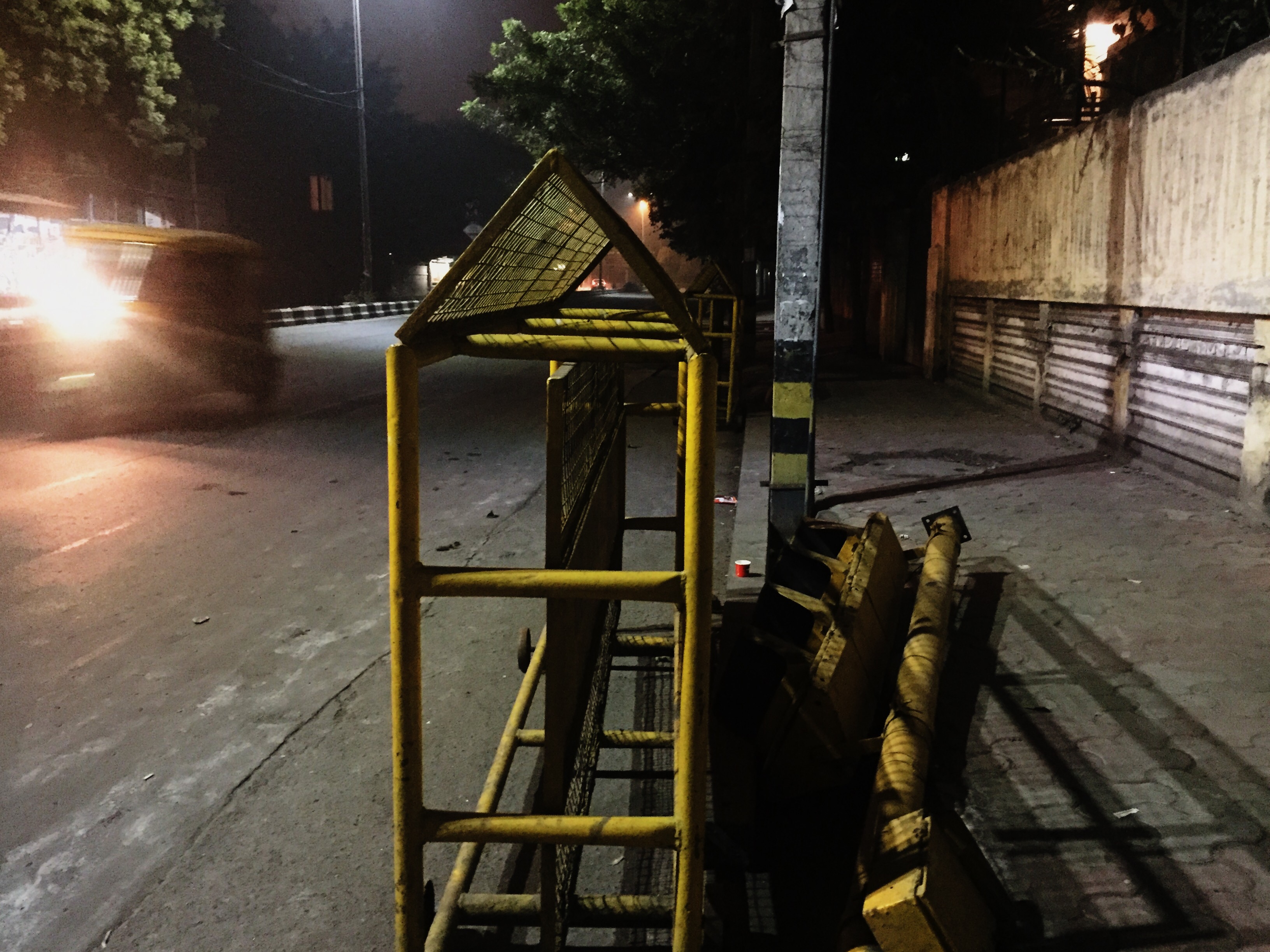
All in all, I passed this dead traffic light sometime last week, and the way it lay, dead and, almost, at peace, as if breathing a heavy sigh of relief, at finally being shut down and unconcerned with human order, disorder, urged me to click a picture, and capture the ruin of state aesthetic that the twenty-first century reeks of, for digital eternity. The police barrier only served to hyperventilate the political imagery of the modern times that the entire spectacle was suspended under. The Indian state today is an increasingly secure one. It has an acute realisation of and a simultaneous disregard, that borders on complacency in an inability, for its monopoly of violence. The mobs rule free, and the smallest of protests are treated with extreme care and attention, adorned in a faux-gold choker. Cheers.
Dhruv.
 Dhruv's Website